


FORM & BRONZE at Art Russia 2026: The Living Tradition of Bronze Sculpture
This year, FORM & BRONZE is once again taking part in one of Russia’s key contemporary art fairs—a space where galleries, artists, collectors, curators, and those shaping today’s cultural agenda come together. For the gallery, this is a significant event: an opportunity to present contemporary bronze sculpture within a large exhibition context, alongside strong authors and projects from across the country.
Our booth this year unfolds as a narrative. We have prepared an exhibition that reads sequentially—from historical imagery to lyricism, from mythology to the human figure. Soon we will begin introducing you to the artists and works we are bringing to the fair.
The fair runs 24–27 September 2026 at Moscow’s Gostiny Dvor. Follow FORM & BRONZE’s news and preparations for Art Russia—subscribe to our channels.
Tradition as Action
The word “tradition” comes from the Latin traditio—transmission. Not storage, but an act that must be repeated; otherwise, tradition becomes a museum exhibit. Bronze casting has existed for thousands of years and has never become obsolete—because each new generation of masters repeats this gesture anew, infusing the ancient form with living, contemporary meaning. FORM & BRONZE does exactly that, right now.
Historical Reconstruction in Metal
Visitors are greeted by “Yermak,” “Kolovrat,” and “The Terrible Tsar” by Maxim Vryasov. The sculptor works with authentic inventories of weaponry and costume from the pre-Petrine era—his images are ethnographically precise and instantly recognisable. Evpaty Kolovrat returns from the ashes of Ryazan, knowing he will not return alive. Yermak stands on the wreckage of a strug (riverboat) at the moment of finale—not victory, but completion. Ivan the Terrible appears in the guise of Archangel Michael, the heavenly commander, as his contemporaries saw him. Three figures, three pivotal moments through which Russia became itself.
The Avetisyan Dynasty: A Dialogue between Paris and St. Petersburg
Alongside Vryasov’s historical works are sculptures by Albert and Arsen Avetisyan. Here tradition is passed on literally—through blood and craftsmanship, from hand to hand. Albert Avetisyan has lived most of his life in France; his monumental works stand in five countries, and he is a member of the French Academy of Arts, Sciences, and Letters. Arsen, his son, worked in St. Petersburg. A special spiritual connection between Paris and St. Petersburg has long existed—and these two embody it.
This time, Albert Avetisyan brings four key works, each revealing his signature plastic language
-
“The Enamoured Angel” (55 cm, 1999). Avetisyan almost never shows the full figure; here he cuts it off at the thighs, steering the eye away from anatomy and toward a state of being. The angel is caught off guard: eyes closed, head tilted toward the shoulder, while the wings behind are no longer wings in the usual sense, but a swift geometric outline—two crossed blades, as if traced by a single stroke of the chisel. A year later, the master would return to this theme in “The Angel’s Dream,” and together the two pieces read as a diptych about an angel capable of feeling—and thereby ceasing to be merely a messenger.
-
“Geisha” (52 cm, 2009). Unlike the fragmented busts with which Avetisyan often explores the female image, here the figure is complete, standing at full height, draped in heavy kimono folds. Patina works as a costume: the deep greenish-black tone of the fabric offsets the gold of the face, hands, and feet, revealing just enough of the body so that inner dignity can be read behind the strictness of tradition.
-
“French touch”. The work speaks directly of the artist’s affection for France, where he has lived and worked for over two decades. His signature technique is pushed to extreme contrast: the female figure is entirely golden, the male figure is submerged in dark patina, as if carved from a different material and a different time of day. The couple is frozen at the most deceptively calm point of feeling—on the brink of a kiss that has not yet begun.
-
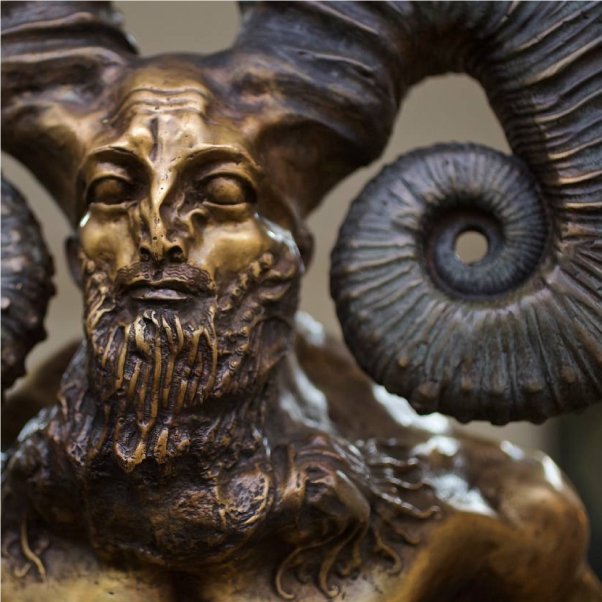
“The Thinker” (124 cm, 2003). This is not an illustration of Rodin’s subject, but a figure of Harlequin caught in a gesture of reflection: legs crossed, one hand raised and bent toward the face, the whole body holding a pause on the edge of movement and stillness. The gilded mask-face remains impassive, while the swift sweep of horn-like locks above the head challenges the immobility of the pose, reminding us that we are looking at a character from the commedia dell’arte—wily, ironic, never entirely serious.
The work of Arsen Avetisyan—his brief but brilliant career—defined the direction of the exhibition “Lines of Life” at ArtRussia 2021. It is no coincidence that “The Thinker” became the emblem of that project: the line, swift and graphically sharp, was the master’s primary tool, and today his legacy continues to resonate in dialogue with his father’s works.
The Language of Archetypes: Animals in Bronze
Animals in Russian culture are neither background nor decoration. The horse, the deer, the eagle—they are a language spoken long before writing, and it has not been forgotten. Anastasia Matsueva does not create from portrait likeness but from movement and wind. An oryx with its head thrown back and horn like a hurled spear. Two celestial horses flowing into one another in something akin to a dance. Her beasts are not illustrations but living archetypes.
Lyricism and the Elements: Andrei Belle’s “Adagio to the Rain”
Andrei Belle goes further—from nature to man. His “Adagio to the Rain” depicts a violinist, exaggeratedly slender and fragile: delicate hands touch the bow, wet clothing clings to her figure, and she holds a note so intensely that her bare toes grip the ground. Adagio—a flowing, sustained tempo. It is in this tempo that the sculpture lives, compelling the viewer to pause and hear the music of frozen metal.
The Crown of the Exhibition: The Beauty Who Outlived Everything
And the crowning piece—a woman. Over two thousand years ago, in the Altai Mountains, a young woman from a people about whom science knows little (neither what they called themselves nor where they came from) was buried. All that remains is what she was interred with: a headdress adorned with a deer and a goat, and a mirror in her raised hand. The sculptor brought this image to life not as a dry reconstruction, but as a living gesture—because, in her words, only then does the image become real. The Beauty Who Outlived Everything. She looks at us through millennia, and bronze allows her to maintain that contact.
Bronze knows how to preserve and transmit. It stands in every significant space, changes with patina, lives. And every time a master takes up clay again, tradition does not end—it continues. We look forward to seeing you at the FORM & BRONZE booth to witness this firsthand.


